Marketing for B2B companies that leads to a contract, not just an inquiry

In B2B the decision is made by a group, not one person: an engineer, a buyer, a finance director, the owner. The deal takes months, and a form submission is only the start of the negotiation. We build marketing for that reality: narrow search queries, content for every participant in the decision, and analytics that reach all the way to a signed contract.

Reply within 15 minutes · project assessment — free · pricing on request

Negotiations at a B2B company: a sales funnel diagram on the screen and tablet, and equipment catalogs with part drawings on the table

Marketing for B2B companies is marketing for a business that sells products or services to other businesses. It is built around a long sales cycle and several decision makers: search and ads on narrow professional queries, materials for engineers, buyers and executives, work with public tenders, a CRM, and analytics that count contracts and revenue instead of inquiries.

Why a B2B company’s marketing doesn’t reach sales

Situations companies that sell to businesses bring to us. Retail marketing tactics don’t solve them.

“We get plenty of leads, and sales says they’re junk”

Reps waste time on students and individuals, while marketing reports a lead count that never turns into deals.

We agree with sales on qualification: what counts as a target lead. We aim ads at narrow queries, add form questions about the company and the problem, and send deal status from the CRM back to the ad platforms.

“A deal takes six months and we can’t tell what worked”

Budget gets cut from channels that actually brought large customers, simply because the contract was signed months later.

End-to-end analytics with a long attribution window: the first source, every touch, revenue per contract. Budget decisions follow money, not clicks.

“The site talks about the company but doesn’t answer an engineer’s questions”

A technical specialist can’t find specifications, certifications or delivery terms and leaves you off the vendor shortlist.

Product pages with technical data, downloadable documentation, application notes and delivery terms.

“Sales depend on a few reps and their relationships”

When a rep leaves, the customers leave. No new companies enter the pipeline, and growth stalls at personal contacts.

A systematic inbound flow: search, content, industry directories, public tenders. Customers come to the company, not to one particular salesperson.

What’s included in B2B marketing

The mix of channels depends on the market: a component supplier, an IT integrator, and a logistics or service company are promoted differently.

Buying committee map

Who starts the purchase, who evaluates, who approves the budget, who signs. Each role gets its own questions answered and its own materials.

Search on narrow queries

SEO and Google Ads on professional queries: part numbers, brands, ISO and ASTM standards, industry terms. Volume is small, but every query is a potential deal.

Expertise content

Technical articles, solution comparisons, walkthroughs of industry problems, webinars for specialists. Content works at every stage of a long cycle.

Segment landing pages

Separate pages for client industries and typical use cases: the same product sells to a food plant and to an oil and gas operator with different arguments.

Public tenders and directories

Monitoring of public procurement notices on SAM.gov and state portals, and profiles in industry directories such as ThomasNet and on B2B marketplaces.

Working the database

Email and touches for companies mid-cycle: new products, updates, event invitations.

Marketing and sales alignment

A CRM, lead qualification, a handoff process and deal reports. Without these, B2B marketing can’t be measured.

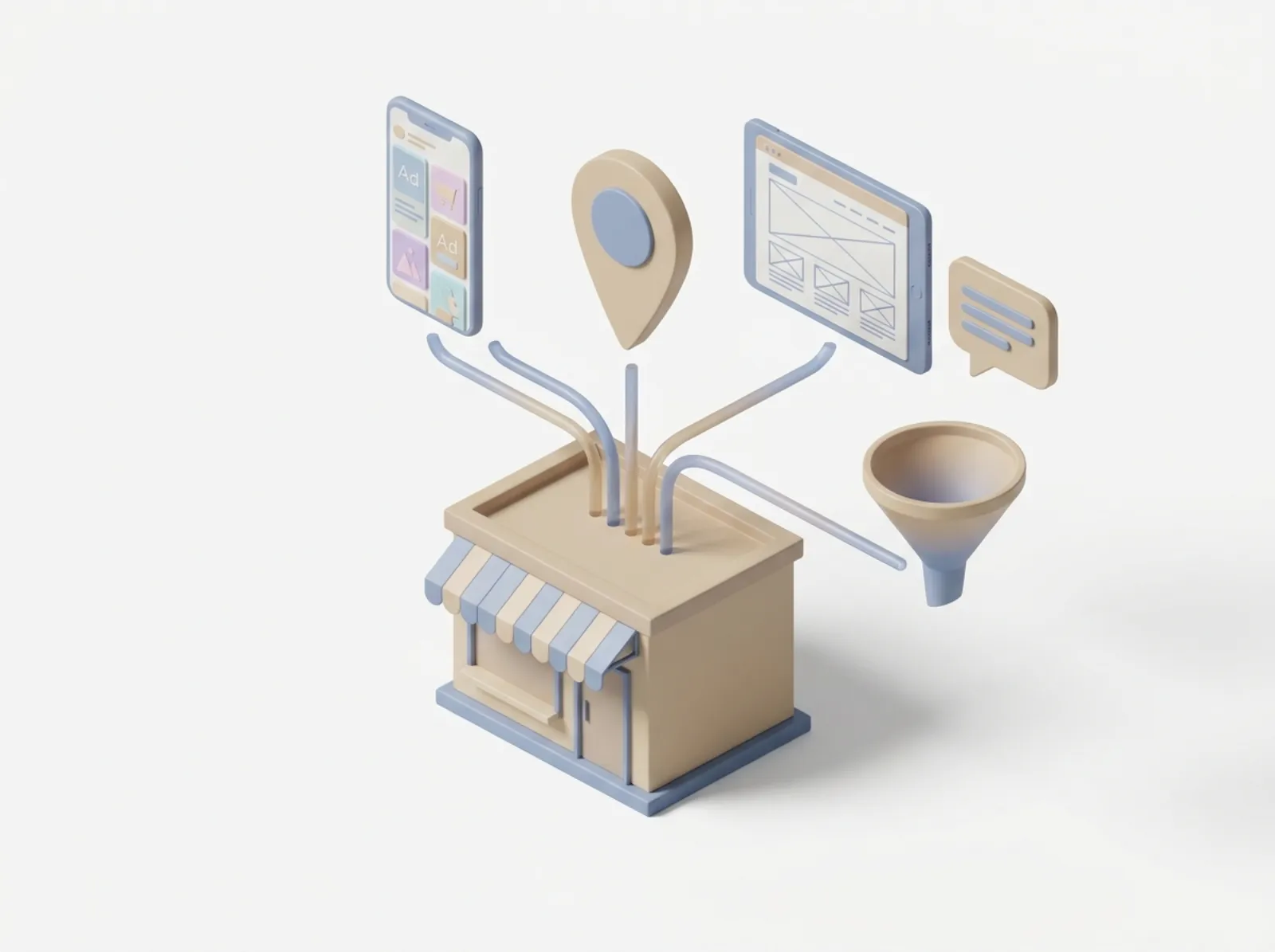
Isometric marketing diagram: a smartphone, a map pin, ads and messages converge on a sales point and a funnel
B2B marketing channels converge in the CRM, so you can see which source took a company all the way to a contract.

Systems we connect marketing to

In B2B, deal data lives in the CRM and the accounting system. Marketing has to see it.

CRM

HubSpot, Salesforce, Pipedrive or Microsoft Dynamics 365: lead source, deal stages, contract value. If you don’t have a CRM yet, we help with implementation.

ERP and accounting

Payments and shipments exported from NetSuite, QuickBooks, SAP Business One or your ERP, so revenue by channel includes repeat orders.

Phone and call tracking

B2B involves many calls, and each should be tied to a source. Call recordings help you understand what customers actually ask.

Analytics

Google Analytics 4, offline conversion imports into Google Ads and LinkedIn, and end-to-end reporting with first-touch and last-touch attribution.

Email and marketing automation

HubSpot, Marketo, ActiveCampaign or Mailchimp, segmented by industry and deal stage and connected to the CRM.

Free audit of your marketing

Leave your contact — we'll show where leads and money leak, which channels to scale and which to switch off. No sales pitch.

Thank you! Request received — we'll get back with your marketing audit within one business day.

The B2B buyer’s path from problem to contract

Every stage needs its own materials. We build marketing for the whole chain, not only for the first inquiry.

Step 01

Recognizing the problem

An engineer or a manager looks for a way to fix something: replace equipment, cut downtime, find a new supplier. Articles and walkthroughs work here.

Step 02

Looking for suppliers

Narrow queries in search, directories, tender portals and referrals. The company builds a shortlist.

Step 03

Technical evaluation

Specialists compare specifications, documentation, certifications and lead times. Detailed product pages and fast answers are essential.

Step 04

Quote

The buyer compares terms. A fast quote, a clear structure and readiness to answer follow-up questions all count.

Step 05

Approval and contract

The decision goes through management and finance. Materials for people who weren’t part of the talks help: a presentation and a rationale for the choice.

Step 06

Repeat orders

Service, consumables, new products. In B2B, most revenue often comes from existing customers.

How B2B marketing differs from marketing to consumers

The first difference is demand volume. A query like “stainless steel bar supplier” or “ERP implementation partner” may have only a few dozen searches a month. That is no reason to skip search: every such query comes from a person with a real problem and a budget. Precise keyword targeting works, and broad reach doesn’t.

The second is several decision makers. An engineer needs specifications and compatibility, a buyer needs terms and lead times, an executive needs risk and economics. The website and materials must answer each of them, or the company loses at a stage where marketing is no longer in the room.

The third is the long cycle. Months pass between the first visit and the contract, and a report on “cost per lead this week” misleads. We link ads to the CRM, send deal statuses back to the ad platforms and evaluate channels by revenue, not the number of inquiries.

If you are a manufacturer, we have a dedicated page on marketing for manufacturers, and for carriers and freight companies, marketing for logistics companies.


B2B marketing channels and when they work

The mix depends on the market and the length of the sale.

ChannelWhen it worksWhat to consider
SEOThere is steady search demand for your products and servicesResults take several months, and you need detailed product pages
Google Ads and LinkedIn AdsYou need a flow of inquiries on narrow queries nowNegative keywords to filter out consumers, and deal statuses fed back to the platforms
Content and webinarsA complex product that needs explainingYour company’s experts have to be willing to take part
Public tendersCustomers are government agencies and large enterprisesYou need documents, procurement monitoring and bid preparation
Industry directories and trade showsThe market is concentrated on a few platformsCapture contacts in the CRM and follow up after the event
Email to your databaseA long cycle and repeat salesCommercial email must respect laws such as CAN-SPAM, and in the EU and UK, consent and privacy rules

Who it’s for, and who it isn’t

A good fit if

  • A company sells to businesses and wants an inbound flow that doesn’t depend on reps’ relationships.
  • You have a sales team and a CRM, or you are ready to set them up.
  • Your sales cycle is long, and you need to know which channels bring contracts.
  • You have a complex product that has to be explained to several participants in the decision.

Not a fit if

  • You need inquiries tomorrow without any work on the site, sales and analytics.
  • The company sells through one distributor and doesn’t work with end customers.

FAQ: Marketing for B2B companies

We quote on request after reviewing the task. The price depends on the number of channels, the market and whether a CRM and analytics must be set up. Ad spend is separate. We break the proposal down by scope of work.
Yes, if you aim it at narrow professional queries and filter out consumers. It matters to send deal data from the CRM back into Google Ads, so the platform learns from real customers instead of any inquiry.
By revenue and deals, not by the number of inquiries. We connect ads, the website and the CRM, keep the first source of each lead and judge channels months later, once deals have closed.
If the product is complex and buyers search by describing a problem, yes. Technical articles and walkthroughs bring in specialists who later become customers. If demand is only for specific part numbers, a detailed catalog matters more.
We help set up monitoring of public procurement notices, for example on SAM.gov in the US, Find a Tender in the UK or TED in the EU, and link it to your CRM so no suitable opportunity is lost. Preparing the bid itself is handled by your team or a specialist.
Companies that sell to businesses: manufacturing, wholesale distribution, logistics, IT and service companies. For each industry we build our own map of decision makers and channels.

Tell us about your business — we'll come back with a marketing plan

In return you'll get an audit of your current marketing, the points where leads leak and a channel plan. Usually within one day. Free and with no obligation.

4 of 6 project slots open this week.

Request received

Thank you! We'll come back with your marketing audit, the points where leads leak and a channel plan — usually within one business day.

More from Growth Bureau

Get an audit