Marketing for education that takes people from a free lesson to enrollment

Education is sold through a trial: a person has to watch a lesson, meet the instructor and believe they will actually reach the result. That is why marketing for an online school isn’t a stream of traffic, it is a funnel from the first touch to enrollment. We build all of it: ads, a free lesson or webinar, nurturing, the sale and completion.

Reply within 15 minutes · project assessment — free · pricing on request

An online school workspace: a laptop showing a video lesson and a sales funnel chart, a notebook and headphones on a wooden desk

Marketing for education is a system in which ads and content bring people to a free lesson, webinar or trial class, nurturing by email and messaging explains the program and answers doubts, and a sales team or an automated funnel closes the enrollment. For learning centers and tutors, Google Business Profile, tutoring marketplaces and local ads are added.

Where an online school loses students

Situations schools, learning centers and instructors bring to us. The problem is almost never traffic; it is a weak link in the funnel.

“Hundreds register for the webinar and a handful show up”

You paid for the registration, and there is nobody to sell to: they skipped the live session and never watched the replay.

A reminder sequence by email and SMS, short materials before the session, and an on-demand version for people who missed it. We measure the cost of an attendee, not of a registration.

“We get course inquiries, but the team can’t call everyone back in time”

A person who submitted a form in the evening is comparing three other schools by morning.

Leads go straight into the CRM with their source, the first message goes out automatically, and the advisor sees which lesson the person watched and where they dropped off.

“They bought the course and quit after lesson three”

Refund requests, poor reviews and no chance to sell the next level.

We connect the learning platform to the CRM: you see who is falling behind, a coach gets a task and the student gets a nudge. Completion is part of marketing, not only the instructional team’s job.

“As a tutor, my students come only by word of mouth”

The schedule empties out over the summer and after exam season, and new students arrive by chance.

A profile on tutoring marketplaces, a page with your method and reviews, and ads aimed at parents in the right area and the right season.

What’s included in marketing for an online school

The mix of channels depends on the model: a school built on webinars, a learning center with in-person groups and an independent tutor are promoted differently.

Product packaging

Who the course is for, what result a student gets and in what time frame, who teaches it and how the program differs. Without this, ads bring the wrong people.

Entry point

A free lesson, webinar, mini-course, trial class or placement test. We choose the format to match how long your audience takes to decide.

Paid traffic

Google Ads, YouTube, Meta, TikTok and LinkedIn for professional courses. Ads and landing pages for each segment: beginners, professionals, parents of students.

Nurturing and email

A messaging sequence between the free lesson and the sale: the program, the instructor, answers to objections, delivered by email, SMS or a community.

Sales

Scripts for advisors, an automated funnel for low-ticket products, payment plans and clear plans on the course page.

Search and content

SEO for courses with steady demand, plus articles and walkthroughs that lead people to your free lesson.

Cohort analytics

From ad to enrollment and completion: which campaign brings students who pay and finish the course.

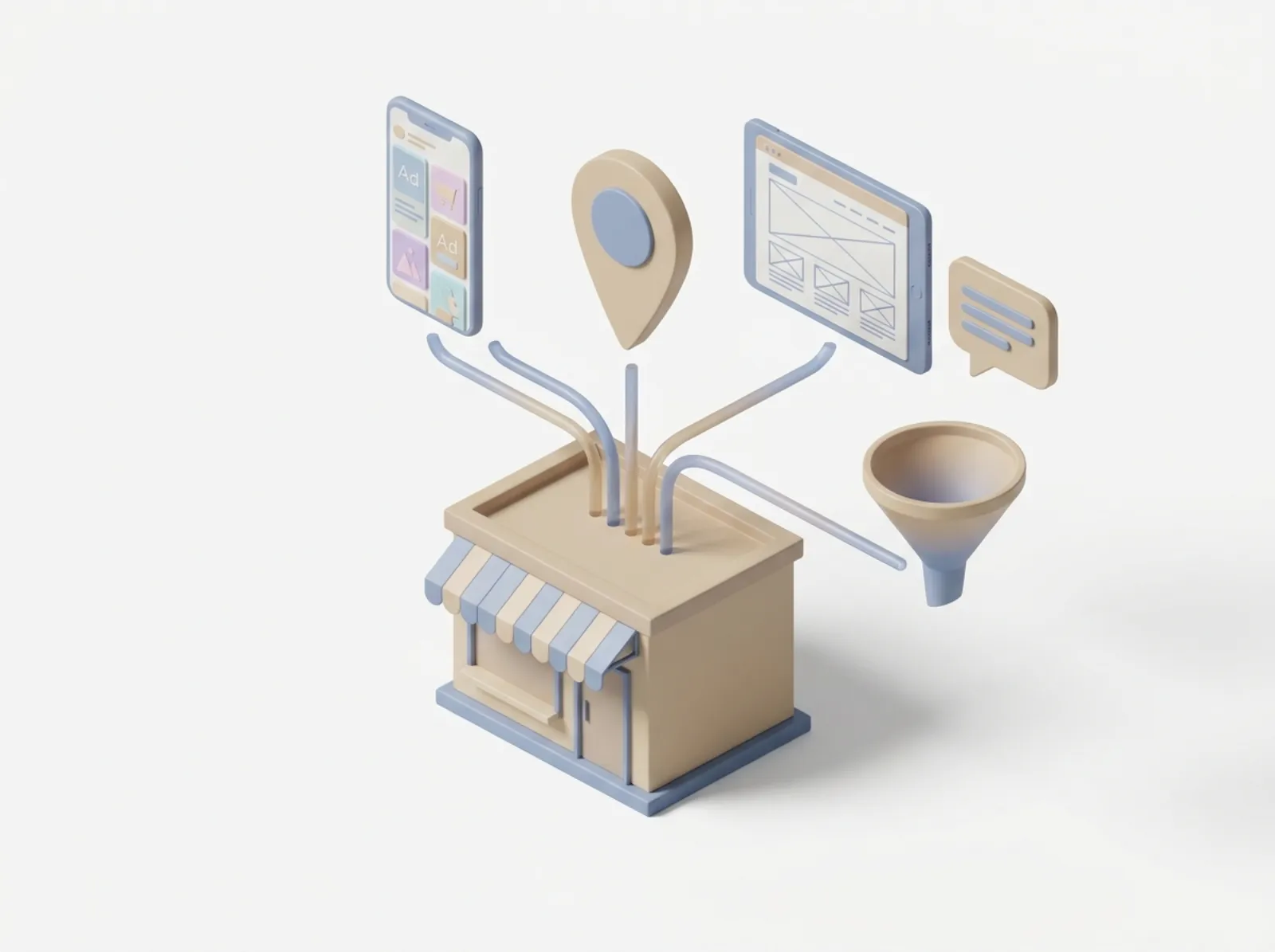
Isometric marketing diagram: a smartphone, a map pin, ads and messages converge on a sales point and a funnel
Channels converge in one funnel, so you can see which source brings students who actually enroll.

Integrations a school needs

We connect your learning platform, payments and sales so you can see the whole student journey.

Learning platforms

Teachable, Thinkific, Kajabi, Podia, LearnWorlds and school LMSs such as Canvas or Moodle: registrations, access and lesson progress.

CRM

HubSpot, Salesforce or Pipedrive for the admissions or sales team: inquiries, touchpoints, deals and upsells to the next level.

Payments

Stripe, PayPal and installment tools: a payment status in the CRM opens course access automatically.

Messaging and email

Chatbots and SMS for webinar registration, reminders and delivering materials, plus email platforms such as Mailchimp, Klaviyo or ActiveCampaign for longer nurturing.

Analytics

Google Analytics 4, UTM tagging and end-to-end reporting: the cost not of a click but of a paying student for each channel, within your consent and privacy settings.

Free audit of your marketing

Leave your contact — we'll show where leads and money leak, which channels to scale and which to switch off. No sales pitch.

Thank you! Request received — we'll get back with your marketing audit within one business day.

The student journey from ad to enrollment

We measure each step separately, so it is clear where the funnel leaks.

Step 01

First touch

An ad, an article, a post or a video. A person learns that their goal can be reached through training.

Step 02

Free product

Registration for a webinar, a mini-course or a trial class. Simplicity matters here: a phone number or an email address instead of a long form.

Step 03

Showing up

Reminders, useful material before the lesson, and a replay for people who missed it.

Step 04

Meeting the program

The lesson shows the format and the instructor. At the end comes the course offer and a Q&A.

Step 05

Enrollment

An advisor or an automated sequence, a payment plan, and a time-limited offer for webinar attendees.

Step 06

Learning and the next course

Progress tracking, coaches, a certificate, and an offer of the next level or an advanced program.

Marketing for tutors and learning centers

An independent tutor and an in-person learning center sell differently from an online school with webinars. The decision is made by a parent or an adult learner who searches near home or online for a specific subject: “SAT prep tutor,” “algebra tutor near me,” “English classes for adults,” “math tutoring in small groups.” So the foundation is a profile with your method and reviews, tutoring marketplaces and local search.

Marketing for a tutor works when each listing is written for a specific need: subject, grade, exam, lesson format, schedule. One “all subjects” listing loses to several precise ones. Marketplaces such as Wyzant or Varsity Tutors can supply the first students, while your own website and Google Business Profile keep the relationship yours. For a learning center, we add geo-targeted ads aimed at parents in your area and a page for each program.

Seasonality is sharp. The main enrollment wave comes in late summer and early fall, a second in January, and in spring demand shifts to exam prep for SAT, ACT and end-of-year tests. We build the ad plan around these waves, and in summer we sell summer intensives and preparation for the new school year. If your main goal is inquiries from search to the school’s website, see our separate page on SEO for education.

  • A separate listing or page for every subject and exam.
  • A trial lesson or a level assessment as the main offer.
  • Reviews from parents and students, and mock-test results without invented numbers.
  • Online booking and payment, plus lesson reminders.

Marketing educational services: accreditation, claims and disclosures

In education marketing, the audiences are the school or instructor, the students and their parents, and employers who order training for their staff. For promotion this means the same course has to be explained to different people in different words: to the student, the outcome; to the parent, safety and oversight; to the employer, the skills the employee will gain.

Be exact about credentials. If a school offers degrees or accredited programs, say who accredits it and keep the wording accurate. If it doesn’t, describe a certificate of completion as exactly that. Rules for private career and vocational schools differ by state, so we check what you may claim before it goes into an ad or onto a landing page.

Sponsored creator posts and affiliate offers must disclose the relationship under the FTC’s endorsement guidelines. Promises of a job or a specific income after a course are exactly what regulators and ad platforms look at most closely, and students read them as a warning sign. We write about the program, the practice and the support format instead.

Entry points for different learning formats

We choose the free product according to the length of the decision and the price of the course.

FormatEntry pointMain channels
Online school with a flagship courseA webinar or a series of free lessonsGoogle Ads, YouTube, Meta, TikTok, creator partnerships
Short courses and mini-productsA low-cost tripwire productPaid social, email and an automated funnel
Learning center with in-person groupsA trial class or an open houseGoogle Maps and Business Profile, local Google Ads, Facebook and Instagram
Corporate trainingA skills audit for the team or a demo lessonSearch, LinkedIn, outbound sales and industry events
Private tutorA trial lesson or a level assessmentTutoring marketplaces, Google Business Profile, referrals

Who it’s for, and who it isn’t

A good fit if

  • An online school with a working course that needs a steady flow of students.
  • A learning center that wants to fill groups with more than word of mouth.
  • A school that sees registrations but can’t tell where sales are lost.
  • An instructor or a small studio ready to build a systematic flow of students.

Not a fit if

  • The course doesn’t exist yet and nobody knows if it will sell. Test demand with a small launch first.
  • You want a one-off launch with promised revenue and no work on the product and sales.

FAQ: Marketing for education

We quote on request after reviewing the funnel. The price depends on the number of channels, the complexity of the funnel and whether your learning platform has to be connected to a CRM. Ad spend is separate and goes directly to the ad platforms.
It depends on the price of the course and the audience. A webinar suits higher-priced programs where meeting the instructor live matters. A mini-course with an automated funnel is better for lower-priced products and for people who won’t attend a live session.
Through precise positioning and the places where parents look for tutors. A marketplace profile for a specific subject and exam, a page with your method and reviews, and a trial lesson. Enrollment peaks in late summer and in January.
The school or instructor, the learners and their parents, and employers who order training. Intermediaries such as marketplaces, course aggregators and partners also play a role. Each group has its own reasons to buy, and the messaging has to reflect that.
Yes. We connect these and other learning platforms to your CRM and analytics, so you can see the path from ad to payment and course progress. If a school moves to another platform, we help keep student data intact.
Not to advertise ordinary courses. It matters when you offer degrees or officially recognized credentials, and then you must state it accurately. Without it, describe a certificate of completion honestly. Requirements for career schools vary by state.
Paid ads bring registrations after launch and ad review, and sales follow the first full funnel cycle. SEO and content build over months. We don’t promise numbers in advance, because they depend on the product, the niche and the price of the course.

Tell us about your business — we'll come back with a marketing plan

In return you'll get an audit of your current marketing, the points where leads leak and a channel plan. Usually within one day. Free and with no obligation.

4 of 6 project slots open this week.

Request received

Thank you! We'll come back with your marketing audit, the points where leads leak and a channel plan — usually within one business day.

More from Growth Bureau

Get an audit